For a very long time now I have been interested in, if not amazed by, some facets of the BBC. Specifically, the equipment used during the formative years at Television Centre. Even moreso with the oftentimes custom-built devices that they used to produce their programs. Much of the equipment that was used in the period from the early sixties to the mid 80s was not used anywhere else. I'm going to do a series of posts working out much of the information that I have collected over the years of how this equipment was used and operated.
Most of the information that I have here comes from a most marvelous website,
TV Studio History that I had lost for a while and recently stumbled upon again. It's a great and well updated account of many of the UK's television studios, including the myriad equipment at Television Centre.
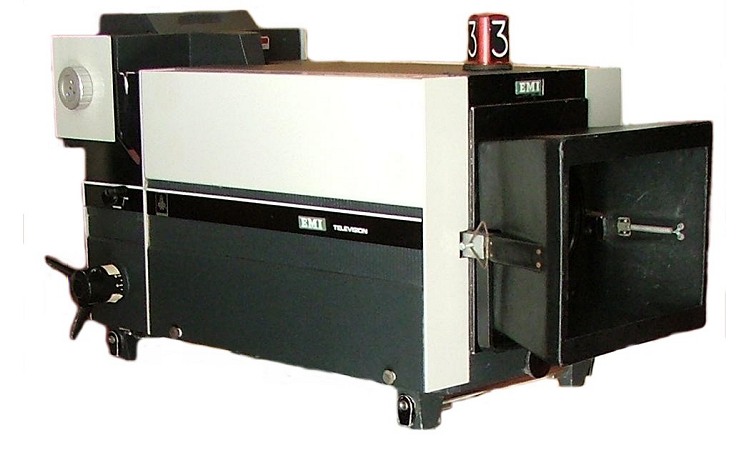
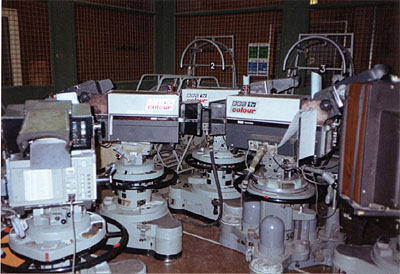
This week we'll be looking at one of the absolute workhorses of the BBC and a favorite camera of mine, The EMI 2001.
 Photo from TV Camera Museum
The EMI 2001 was quite special in the sense that it actually lived for a very long time. The last of its kind was finally retired in the early 90s, probably when they could no longer keep them alive off of spare parts. Not bad for a camera made in the mid 60s. The story seems to go that they were kept around because they were extremely good at reproducing pictures. Despite using plumbicon tubes, their pictures seem much sharper than say the American equivalent the Norelco PC-70, if you could really call it that. What was so special about the way that the 2001 produced its color picture was that it used 4 tubes instead of three, like most other color cameras. The fourth tube was used as a luminance tube, generating the black and white signal that would be added to the color (chrominance) signal generated by the other three tubes. I'll discuss how this works in a little bit.
 The last 2001s to be used by the BBC at Elstree studios on the day of their retirement in the early 90s. Photo from wikipedia.
The way that the BBC happened to order these cameras is quite an interesting story. The BBC had been doing color tests for years trying to figure out a system that would be compatible with the existing black and white standard. There is a great video of this on youtube that gives a (staged) look into these tests as early as 1960. These first cameras were based on the RCA TK-41 and were manufactured by Marconi. By the time the BBC had decided they were ready, around 1966, EMI and Marconi had developed color vidicon cameras that were being considered. EMI had produced the 2000 and Marconi the MK VII. Disappointed with the quality EMI offered, the engineer bought around 7 Marconis to outfit the first color studios, TC6 and TC8.
For a minute I'll talk about the Marconi. The Marconi MK VII was a behemoth of a camera. It was super long and the body of the camera was large and heavy. Any pedestal that these were mounted on required a larger ring to steer it with. In addition, the lens used was made for an Orthicon camera that had a much larger sensor (probably about 3 inches) that when used with the much smaller vidicon sensors had the effect of reducing the area picked up and "lengthening" the focal length of the lens. The result was large, long, heavy cameras that had to be long distances away from their subjects to get the shots they needed.
 A Marconi MK VII. Operator provides a reference for scale. Photo from Tech-Ops History
In this time, EMI went back and revised the design. They replaced the vidicon tubes with Plumbicons (lead-oxide based vidicons) and made some other tweaks. The engineer, realizing his mistake, bought the new EMI cameras, now designated 2001, and soon all of Television Centre was outfitted with EMI 2001s. The leftover Marconis were moved into the presentation and news studios, camera movement being less of an issue in those programs. Oddly enough, the presentation studios are where
Old Grey Whistle Test originated from, which must have been difficult with a small studio and large cameras.
The way that the EMI camera overcame the difficulty of the large amount of circuitry needed to operate the camera was twofold. First, most of the controls were moved to the Camera Control Unit (CCU) requiring quite a heavy 101-core cable to connect the two. Second, the remaining circuitry was wrapped around the lens of the camera. The little bump at the front of the camera is just a lens hood. The lens is completely internal to the camera. This decision made tilting the camera much more intuitive and balanced, but limited the types of lenses that could be used with it.

 Exposed sides of the 2001. Top photo shows large camera cable in center bottom. Photo from Radio and Electronic Engineer 1970
 An exposed EMI 2001 lens, showing servos. Photo from TV Camera Museum
The lens itself was also quite interesting. There were provisions so that the entire camera could be remote controlled, therefore the lens is controlled entirely by servos. This aspect allowed the camera to be very operator friendly. A panel on the back allowed the operator to set zoom presets. It was speculated that these were made to emulate the older style turret system, so different focal lengths could be programmed in and switched to with the press of a button. Too often I have wanted a control like this on modern cameras... Focusing was done with the three-spoked knob on the right hand side of the camera, reminiscent of the focus controls of the older cameras.
But. How does it look?
Actually, quite amazing. There's a reason these cameras stuck around for so long. When in a well lit studio they had quite good color reproduction and very good black levels. They got noisy in low light situations though. Only every so often was there an issue with image lag. The EMIs did not have any form of ACT (anti-comet tail) circuitry so whenever a glimmer of something bright was caught, it did blur across the screen, oftentimes in a multicolor spread. Machines that were kept late into their lives were often upgraded to add such circuitry but a good number of parts needed to be changed in order to do it.
To find good copies of many programs on the internet that were filmed with EMI 2001s is somewhat hard. Most of it was recorded onto Quadruplex tape, known for its quality, but has often been transferred onto other and inferior tape formats (or compressed to death digitally). Some of the best looking footage not from a sit-com is actually a program made in 1969 called "Pop Go the Sixties," a retrospective of 60s music produced by the BBC and ZDF, a German television company. This clip of Lulu on the program demonstrates its quality quite well.
Keep an eye out for stray lens hoods and cross-shots! (this program was kind of littered with that...)
The reason the camera is so sharp is due to its unusual design. Most cameras being made at the time (and to this day) were made with three sensors- red, green and blue. The signals from these are then combined to create the luminance and chrominance signals that make up the compatible color system. The EMI however, uses a fourth tube to create the luminance channel. The only other place I have seen four tubes used in this fashion was in RCA telecine cameras (The RCA TK-42 and 43 used a similar technique, but they used an orthicon tube for lum. and vidicon tubes for the color signal). The design makes the camera heavier, but offers more versatility with the tubes regarding color accuracy, sharpness and deficiencies with the tubes.
I have a document released in
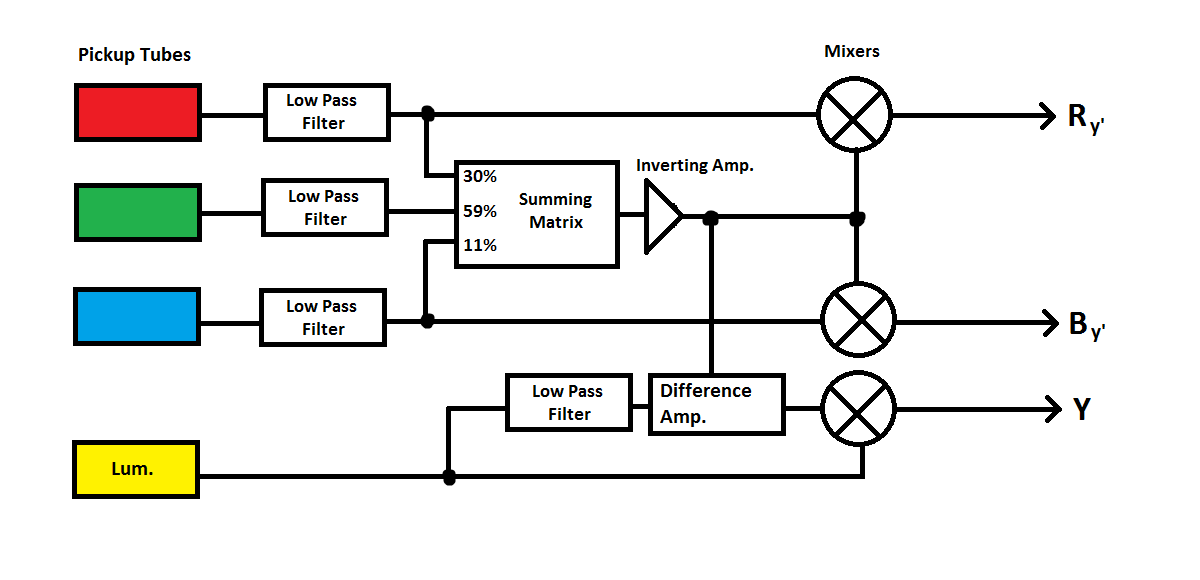
Radio and Electronic Engineer in 1970 that details the operation of the 2001. It gives a comprehensive description of the background, optics, electronics and mechanics of the 2001. The most interesting, or perhaps mystifying, part that it describes is how the colorimetry of the four tubes is performed. Like a standard camera, the 2001 creates a luminance signal by blending the color tubes together. But instead of blending this signal directly with the red and blue signals to make the chrominance signals, it creates a difference signal with the bandwidth restricted signal from the luminance tube, then blends that difference signal with the full-bandwidth luminance signal. This is shown diagrammatically in the pictures below, first the three tube, and then EMI 4 tube version.
 The standard method for deriving the luminance and Chrominance signals from a camera.
 Signal generation in the EMI 2001 utilizing four tubes and "Delta L" luminance correction.
EMI's reasoning for this style of signal generation was due their belief that the luminance signal that is generated from the luminance tube is different from the signal generated from the blending of the color tubes, especially when the camera is aimed at saturated colors. This "delta L" signal could be used for a number of purposes, one in particular being to correct for color insensitivity in the luminance tube. The tube could be bolstered to produce greater luminance in, say, the red spectrum if it needed it. All the while, the luminance signal would still have the advantage of the crispness afforded to having a separate tube. It is most likely that the Marconi MK VII (which was also 4-tube) used the luminance tube directly, without accommodating for this error, and many people did not like the color color tones it produced as a result, specifically flesh tones.
To end this piece I will leave you with a video demonstrating the operations of the EMI 2001. There are plenty of other videos out there featuring this camera, but this two-part video provides a really good look at all the features of the EMI.